
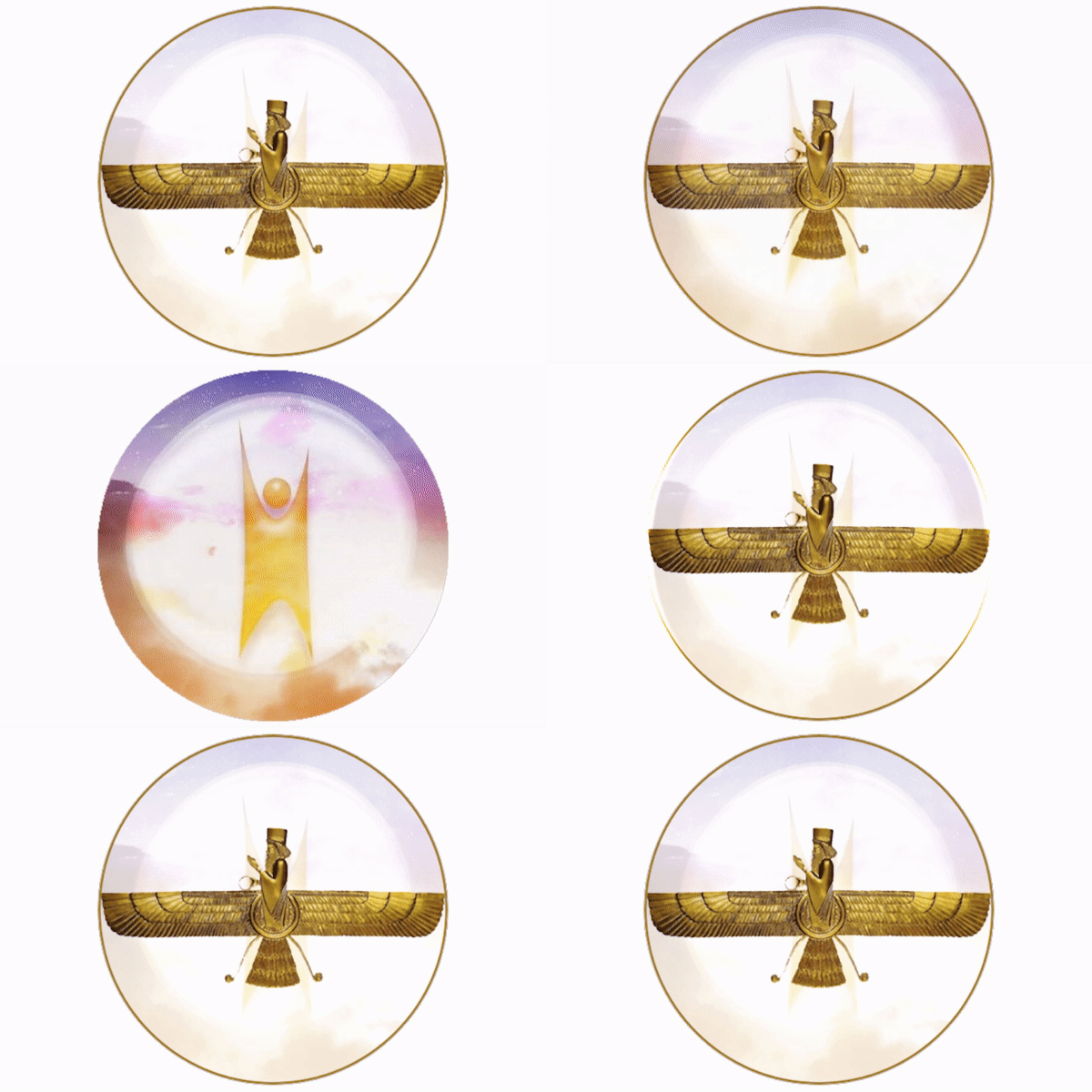
The Iranic Humanism

Updated: Aug 9

Happiness depends on a double string, intertwined by inner- and outer welfare. I have perceived a concept which, based on my insight, I call “The Iranic Humanism.”
In Iranic Humanism, the human being stands on her/his own feet through self-awakening and mentally has no need for any external crutch in order to survive. Through mastery of her/his own mind, she/he is in balance by her-/himself, and thus greater than the life—is a pārsā (an Übermensch, or a little sample of God, a god).
The Iranic Humanism is an interpretation of Humanism which, in terms of self-knowledge and worldview, is founded upon the Mazdayasnian insight, and at the same time, from a socio-economic standpoint, follows Social Democracy as “human-centered capitalism” or “modern capitalism.”
The most appropriate explicit and telling sign for The Iranic Humanism is the sign of Farrehvaharr, or Farrehvashi in the Achaemenid dialect, which originates from Aryan thoughts or in other words Iranic thoughts.
WhyIranic?
The word ”Iranic” is driven from the term Iran which in its anciant dialect was pronounced as ”Arya”. Aryan people which also means Indo-European people, indicates a large part of the people living from India to Europe. And since the Europeans were Aryan immigrants who also settled in the Americas, Australia, and New Zealand, it can even be said that many of the people in these lands are originated from Aryans and therefore can be called Iranians.
The Origin Of Humanism
The school of Humanism was emerged during the European Renaissance, and as usual, Europeans preferred to search for its roots in the most ancient parts of the European continent; therefore, they referred to narration of Socrates and Plato. Later, more open-minded Europeans also pointed to sayings of Confucius.
However, the background of Humanism predates all of these and goes back to the world’s first renowned teacher, Zarathustra, and his Gathas. From this perspective—and considering the argument above, I name my insight as “The Iranic Humanism.” Especially considering some famous humanistic behaviours of ancient Iranians such as Cyrus the great and Darius as well as their successors including both in Achaemenid, Parthian and the beginnings of Sassanid era.
Mazdeyasnic Insight
Anyone, with any belief, who desires the victory of goodness over evil, and who—so long as she/he strives in this direction through good thoughts, good words, and good deeds—is a Mazdayasnian. The Mazdayasnian insight as the agent of inner welfare, is an Achaemenid insight derived from the teachings of Zarathustra, because—as Professor Khosrow Khazai (Pardis) notes—the term Ahu-ra-Mazda as the foundation of the Mazdayasnian insight appears more frequently in inscriptions located in Parseh (Persepolis), whereas in other locations one more often encounters the terms Mazda or Ahura or the combination of Mazda Ahura. Therefore, it is likely that the compound term Ahu-ra-Mazda was an perception of Darius the Great himself or of thinkers of his era.
The Mazdayasnian insight differs from Zoroastrian religion because, first and foremost, it is an insight (a perspective), not a religion. It is based on the Gathas, or sayings attributed to Zarathustra himself, and after logical examination it may be accepted or rejected; it is also open to change—unlike religion, which is founded on faith or blind and immutable belief, and whose imposition by any means, even dissimulation, deception, and crime, has been common.
Whereas what after Sassanids is called Zoroastrian religion is a "commerce center", like other religions—albeit with much less violence—based on residual ideas preserved among the people some three hundred to more than five hundred years after the Achaemenids, and compiled and innovated by the Parthians and Sassanids into a collection called the Avesta.
For further information on the Mazdayasnian worldview, in addition to related articles in the “Inner Welfare” section of this site, please also refer to Stories 1 through 3 in this site.
Social Democracy
The Social Democracy as the agent of outer welfare also is a method introduced by Europeans, but since the history of such an approach in Iran goes back at least to the time of Mazdak, and since Europeans are also Aryan and therefore Iranian, I consider it an Iranian policy that forms the other foundation of The Iranic Humanism because it helps people to economically and socially stand on own feet. For more information on the idea of Social Democracy, please refer to the “Outer Welfare” section of this site as well as story 14.
Be healthy, balanced, victorious, and pārsā!
In the support of Ahura Mazda, which we are of!


Comments