
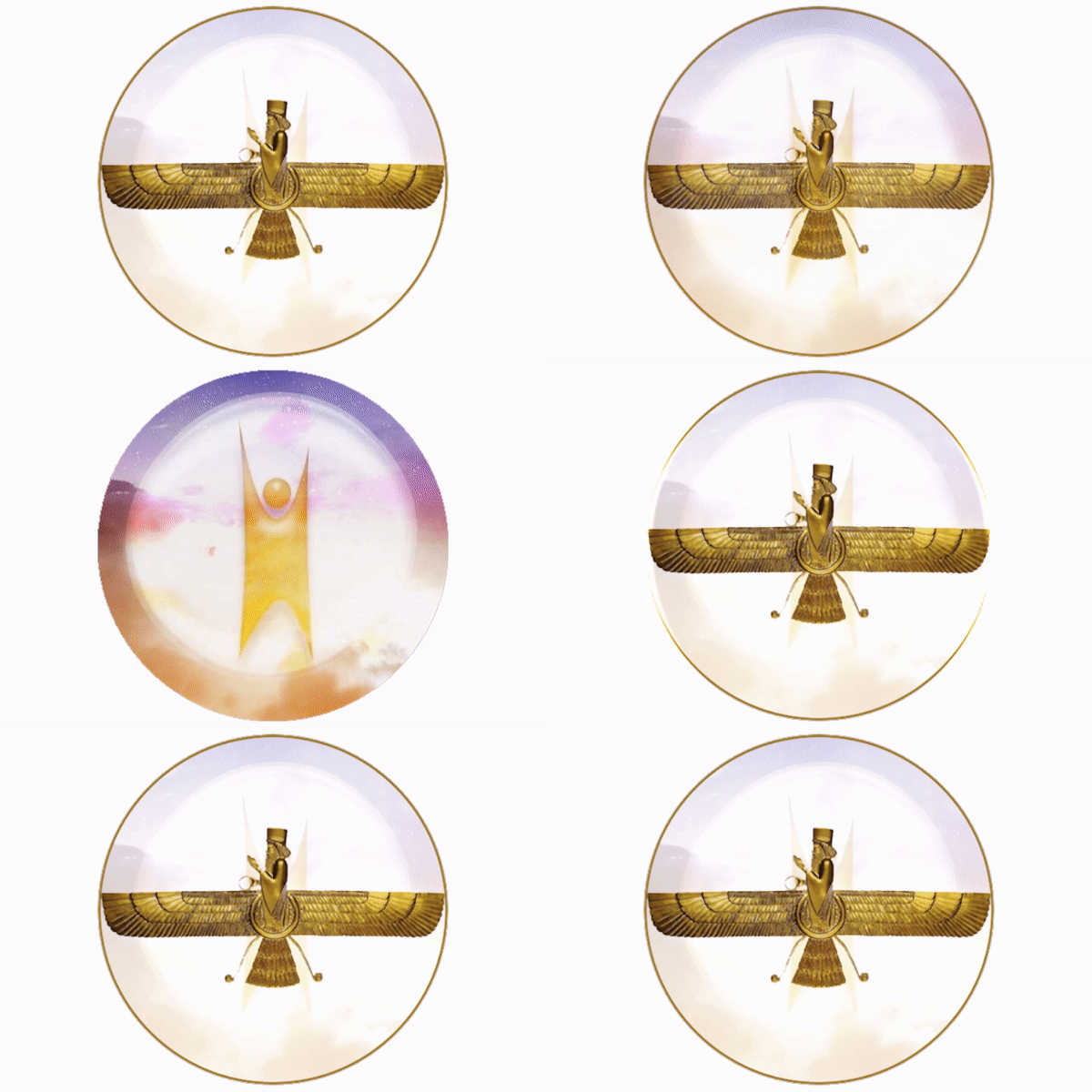
The Mazdeyasnic Insight
- arionahram

- Jan 17, 2023
- 13 min read
Updated: Feb 16

I like the Humanism a lot. It is modern and intellectual. I think it is a step towards final goal of human in life. That is why I have chosen to be a laic Humanist.
But in parallel with it, I found the new "Mazdeyasnism" as an ancient path that is very much in line with the views of humanism without disturbing the secular aspect of it. Zarathustra or the person behind this guidance is older and more relevant to the meaning of Humanism than Plato, Socrates or Confucius. Therefore, I want to present this insight to others as well. Hope it gives them at least the same joy that gives myself.
An insight and not a religion
Mazdeyasnism is not a religion. It is an Iranian or Aryan insight. Aryan or rather Arya is the old pronunciation for the name Iran. In its old form, it has nothing to do with the Nazis. But Iran and Arya are the same thing and the very word Indo-Europeans as a link between India and Europe is the same as Iranians.
Mazdayasnian insight is an ultimate worldview and body of knowledge of self-recognition and Aryan (Iranian) insight—not a religion. Religion is a Semitic marketplace of exchange that considers seers to be prophets. The process of religion-making and prophet-centered belief is specific to Semitic religions, to the extent that it has produced 124,000 prophets—prophets who, from all parts of the world, have appeared only in the Semitic-inhabited region of the Middle East.
The reason for this lies in the separation of their god from what they call his servants—servants who, due to perpetual indebtedness, are constantly deemed sinful, unworthy of direct contact with their god, and therefore require a prophet to convey their god’s message to them.
The insight of the Zarathustra
By contrast, according to Zarathustra’s insight, existence itself is Ahura Mazda, and the human being, as a part of existence, is not separate from it and therefore does not require a messenger. Zarathustra himself, in the Gathas, calls himself a “mantran”—a teacher of thought-provoking words.
As mentioned, in the Mazdayasnian worldview, existence is Ahura Mazda, constantly in development and evolution. Ahu-ra-Mazda means “existence-possessing-great wisdom,” or in other words, existence endowed with great wisdom. This existence, which is Ahura Mazda, is not omnipotent, since deficiencies and imperfections exist within existence itself. For this reason, human cooperation in evolution and in remedying these deficiencies is one of the distinguishing insights of Mazdayasnism.
Mazda, the wisdom of the Existence
The wisdom of existence—called Mazda—is formed on the basis of two poles: Spenta Mainyu and Angra Mainyu. Spenta Mainyu, or beneficent wisdom, is the twin of Angra Mainyu—the malevolent wisdom (Ahriman)—and stands in eternal opposition to Spenta Mainyu. Spenta Mainyu is a creative force; Angra Mainyu, which gradually became Ahriman, is a destructive force. What emerges from the Gathas is that Ahura Mazda, or existence, is everything and therefore one; there is nothing else to stand against it. Nowhere in the Gathas does Angra Mainyu or Ahriman stand opposite Ahura Mazda—rather, it stands opposite Spenta Mainyu.
The documentation of the Zarathustra’s word
The authoritative source of Mazdayasnian insight is the Gathas, whose meanings had been forgotten even by their memorizers and guardians from the end of the Achaemenid era until a few centuries ago. Revered priests who had memorized the Gathas verbatim over many centuries invented, during the Parthian era, the Din Dabireh script—one of the most advanced writing systems in the world, capable even of recording musical notes—and transmitted the Gathas exactly as they were spoken by Zarathustra.
However, the meanings of these words were forgotten and sometimes distorted, until European scholars, a few centuries ago, deciphered the text and the true insight of Zarathustra was revealed again after thousands of years. The European Renaissance and the school of humanism, formed during that period, consider themselves deeply indebted to the Gathas of Zarathustra and the writings of Plato—Plato whom Aristotle, his student, said derived all of his teachings from Zarathustra.
The Avesta is a compilation created during the period when the Gathas were not properly understood, assembled from scattered ancient and later sayings. It not only has less connection to Zarathustra’s own words but is sometimes contradictory to them and even internally inconsistent. Nevertheless, its documentary value in linguistics and archaeology cannot be denied.
Gathas are based on two main pillars
The purpose of life is to create a balanced and happy life for all living beings on Earth.
The purpose of human existence is to assist Ahura Mazda in the evolution of existence and life, and in establishing peace and tranquility within it.
There are two worlds in the Gathas
The material world, which is tangible
The mind (mainyu) world or the world of mentality, which is intangible and exists within the thought and mind of living beings. Another name for this mainavic world is the Farrevashi world.
It is not an exaggeration to say that humans spend more than ninety percent of their lives through mental activity within their minds. This world surrounds us like air envelops living beings on Earth and connects all living creatures through mind. The psyke functions like Wi-Fi, connecting living beings to one another; the brain is like a computer processor; and mental activity, guided by an operating system and software (analogous to wisdom), can be considered the desktop for processing thoughts and emotions. The foundation of the mainavic world is two ever oppositional pillars of Mazda—great wisdom. Human thought does not emanate solely from the brain; it is also a reception based on resonance between individual wisdom and Mazda, the great wisdom. Other components of the mainavic world—mind, psyke, and others—are symbolized in the Farrevahar. The mind itself consists of thought and sensation, where thought stimulates sensation and sensation inspires thought, forming a perfect circle.
These two worlds are interconnected during our lifetime. As long as this connection is maintained through Spenta Mainyu, we remain balanced and healthy; when disrupted by Angra Mainyu, we lose balance and become ill. Everything received by our conscious mind is archived in the subconscious and later corrected by Daena—our conscience or inner wisdom—guiding us. Upon death, the brain transforms into other materials, and thus mind dissipates, but Daena, as part of Mazda, reunites with Mazda. Meanwhile, our thoughts, words, and deeds remain through their effects on the DNA and minds of descendants and may be transmitted to future generations. Thoughts like those of Zarathustra, words like those of Ferdowsi, and deeds like those of Cyrus remain alive for thousands of years and will continue into the foreseeable future. Zarathustra calls this reunion of Daena with Mazda and this enduring presence in living minds the “House of Song.”
In the Gathas, Zarathustra formulates six laws
The existence of duality or opposing poles in existence—nothing has meaning without its opposite.
Good phenomena promote happiness and evolution; evil phenomena obstruct them.
This evaluation exists only in the minds of living beings—in the mainavic world (the world of mentality).
Humans possess wisdom to discern good from evil; emphasis on rationality is a defining feature of Mazdayasnian insight.
Living beings have free choice; life is based on choice, and therefore Mazdayasnian insight has no commands or decrees—everything is freely chosen.
Based on action and reaction in existence, responsibility for our actions lies with ourselves.
In Mazdayasnian insight, there is no sin or divine reward, and being Mazdayasnian is not achieved through faith or belief, but through personal understanding, through insight. Insight (understanding) arises through wisdom. When wisdom is absent, blind belief becomes necessary, and fear gives rise to faith. Once understanding emerges, neither faith nor rituals are required. Accordingly, even the wearing of the sedreh is a personal choice.
Emshaspandan
Zarathustra identifies six mainavic attributes for Ahura Mazda and for the perfection of beings, called the Amesha Spentas (“progressive forces”):
Asha (Arta): perfection, truth, harmony—the cosmic order and ideal toward which existence evolves.
Vohu Manah: good thought—connection between human thought and the benevolent thought of existence (the Spenta Mainyu).
Khshathra: self-mastery, dominion over one’s own mind.
Armaiti: inner peace, from which peace radiates into thought, speech, and action.
Ahurvatat: completeness and evolution—the fulfillment of existence’s deficiencies through human cooperation.
Ameretat: immortality—the enduring remembrance of one’s thoughts, words, and deeds in the mainavic world.
Existence itself is eternal; only its components change form. Human physicality transforms after life, but personality and mental impact may remain in the mainavic world.
In the course of evolution, artificial humans may one day be created who can endure indefinitely in the material world, and advances in genetics may one day allow physical immortality and even the reconstruction of past personalities.
The conclusion
Thus, Mazdayasnian insight is humanistic, and it is not incorrect to view it as foundation of humanism: humans are autonomous agents assisting existence itself—not passive servants bound by blind obedience.
Consequently, the Mazdayasnian worldview is a humanistic worldview, and it is not misguided to consider it a foundation for the emergence of the school of humanism. This is because, in this worldview, the human being—rather than being a passive servant subject to blind obedience and faith-based submission to the command of a superior force—is regarded as a motivating and active agent who assists Existence, or Ahura Mazda, in the victory of truth and goodness along the path of cosmic evolution. As previously mentioned, the human being is an autonomous and active force in the process of Ahura Mazda’s evolution and in the triumph of goodness and truth over evils, possessing the right of free choice based on one’s own reason. It can thus be claimed that the human being occupies a central position.
One might then ask: when Ahura-Mazda is introduced as the possessor of great wisdom, it does leave us with no alternative but to interpret “Mazda” as “great wisdom”. We know that great wisdom is formed on the basis of two poles: Spenta Mainyu and Angra Mainyu. Therefore, the repeated praise of Mazda in the Gathas and the request for guidance from It amount to praising both Spenta Mainyu and Angra Mainyu, and consequently asking both of them for guidance—something that seems contradictory to the effort to combat evils, namely Angra Mainyu or Ahriman?
The answer is that Mazda exists ”on the basis of” opposing poles, but Its decision in judgment and choice depends on Itself, and whatever basis It chooses is rightful.
Another point is that the human mind is divided into two parts: the conscious and the unconscious. The conscious mind is the king of our existence; it thinks, discerns, and is connected to our will. The unconscious mind is the library and libererian of our existence, which archives, among other things, the determinations of the conscious mind and also contains an accumulation of natural instincts. Likewise, inherited behaviors from our relatives are stored there as well. Of course, habits or repetitions that occur through the determination of the conscious mind also become acquired or non-natural instincts and are stored there. The unconscious mind operates involuntarily and automatically, and therefore much faster than the conscious mind. It is this larger portion of the brain and it's function called mind that can be influenced by external indoctrinations through the mainavic world. Thus, in a matured human being, reliance is placed more on the king of one’s existence—the conscious mind—while also making use of the rapid reactions of the library and librarian of one’s existence, the unconscious mind.
According to the latest hypothesis I have perceived, whatever existed prior to the Big Bang was likely an infinite, eternal, and balanced substrate in terms of possessing both matter and antimatter. This is what we currently refer to as dark energy and dark matter (energy is another state of matter, and vice versa). The existence of dark matter has not yet been proven, but what is certain to scientists is the existence of an entity whose effects on space, time, mass, and the relationships between celestial bodies are undeniable.
At a specific time and for reasons still unknown, a great Big Bang occurred within that substrate, disrupting this balance through the leap of antimatter from portions of that substrate and its expansion outward from the Big Bang. What remained was a combination of dark matter and ordinary matter, while the ejection of antimatter toward the outer boundary of ordinary matter and its expansion outward left more ordinary matter behind.
This expansion also means that antimatter continues to separate from dark matter at the outer boundary of ordinary matter and is ejected outward into the realm of older antimatter. This is similar to the forward movement of an ocean wave and its foamy crest—except that, unlike foam, there is no shoreline in front of antimatter. The movement takes place within an infinity.
Now, if that substrate is of the same nature as thought itself, then perhaps this substrate is the great wisdom—or Mazda—which exists, is infinite, and, let us not forget, the world of ordinary matter constitutes only a negligible fraction of that substrate, namely Mazda. Thus, this substrate may also be considered primordial existence. Furthermore, this substrate could be a static and intrinsic repository of physical laws, which in addition possesses the ability to process information interactively while in contact with the world of ordinary matter. Through what instrument this processing occurs may be somewhat elusive to our material perception and experience, but Mazda existed before ordinary matter and, due to Its infinity, constitutes the vast majority of “infinite” existence—at least until the time when the world of ordinary matter itself expands infinitely within that substrate (if such a thing is possible).
Now, this substrate—within which balance is maintained and which is defined on the basis of two opposing pillars (the opposing pillars depicted in the symbol of the Farrevahar)—connects, at the moment of the formation of the human embryo, through a join-point identified as Daena or conscience, to that substrate. In this case, after death, an archive of the human personality is also recorded within that same substrate, namely the great wisdom, and becomes united with it.
I suffer from cancer, and it is possible that I may not live beyond the years 2029–2030. I am very curious to experience whether an entity exists after death or not. If it does exist, then in addition to meeting those who have passed away, I may also be able to experience the accuracy or inaccuracy of the above hypothesis.
Afshin Nariman, the host of the program Apozit, presents a theory that is noteworthy. In his video Khodaynameh and its sequel—which consists of questions and answers regarding the previous video—he states that before the occurrence of the “Big Bang,” physical laws must have existed according to which a Big Bang occurred. These intangible laws can be interpreted as a form of wisdom, which differs from the notion of a hypothetical sovereign ruler in Abrahamic religions—an absolute and immaterial omnipotent being who commands “Be,” and it is, thereby dominating existence as well as human destiny and mind. However, Afshin's interpretation aligns with the concept of the great wisdom, or Mazda, of Zarathustra. Therefore, it appears that these laws can be a form of wisdom that governs the order and formation of existence, has always existed, and will always exist.
In my view, the desirable balance lies in paying attention to the worldviews of our predecessors, including Zarathustra, and gathering their essential insights, while avoiding fundamentalism and not expecting absolute reality from these worldviews. Our predecessors may also have been insufficiently informed or may have had flaws in their perspectives—discoveries that are more accessible to us today and will be even more accessible to future generations.
Unlike Semitic religions, it is not claimed that Zarathustra received revelation from a sacred power that is infallible and whose revelation must therefore be free of error. The Mazdayasnian worldview consists of Zarathustra’s insights, which—like other natural phenomena—may have been subject to error or lack of information. However, this should not lead us to ignore the essential ideas expressed by Zarathustra, such as the unique and outstanding concept of “existence endowed with great wisdom.”
Likewise, the beauty and truth of the idea of two worlds—the material and the mainavic, or the Farrevashi—cannot be ignored. The idea of the purpose of life and the human mission; the idea of Asha, or Ahura Mazda’s—or existence’s—movement toward perfection; the idea of the Amesha Spentas; the emphasis on reason and freedom of choice; as well as the guiding principle of good thoughts, good words, and good deeds, and other ideas of Zarathustra, are essential gems that should never be lost. Rather, in accordance with Zarathustra’s own idea, one should strive for their evolution—or for the evolution of the Gathas. In other words, it is better to remain grounded, realistic, and balanced.
In conclusion, it is added that when engaging with those of differing views, the goal is to be guided—and to guide others—toward goodness and truth, not to sell one’s mind to hostility and resentment and thus act in an Ahrimanic manner. No one is meant to be forced into accepting an idea through anger. Hostility and resentment are Ahrimanic and vile phenomena that arise in the pursuit of imposing ideas.
(The interpretation of Mazdeyasnism in this text is for the most part notes from lectures by Dr. Khosro Khazaei (Pardis), the founder of the European Zarathustrian Foundation in Brussels, as well as a few manipulations and additions of myself. For more information about the new Mazdeyasnism, please visit the foundation's website)
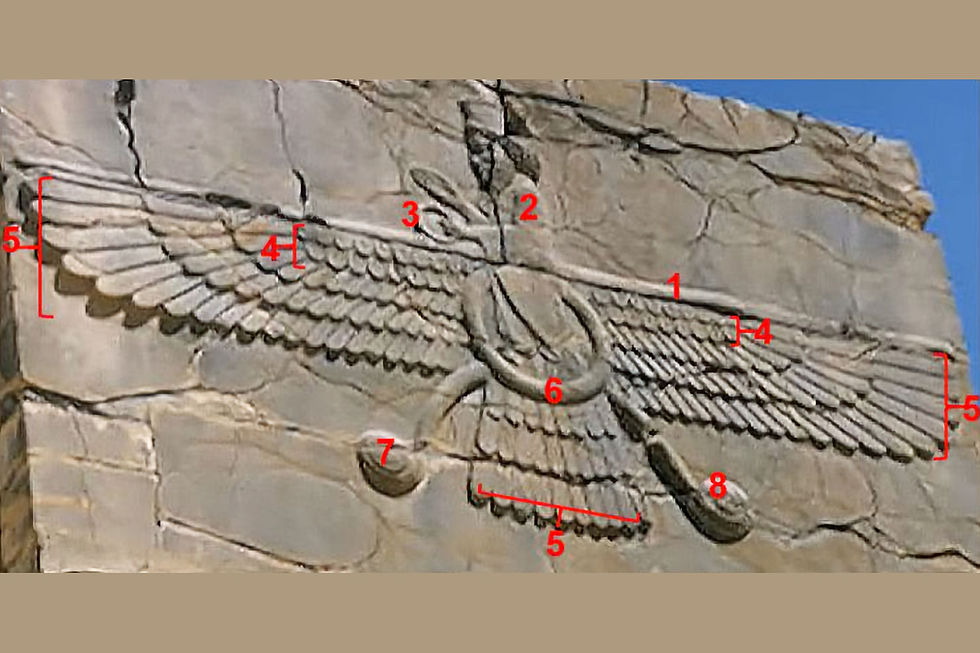
Farrehvashi (Total Consciousness) = The Mainyu World Encompassing Existence, “Existence-Endowed with-Great Wisdom”
The unknown component that stabilizes the structure of Farrehvashi may represent a portion of ordinary matter within existence (please refer to section 5), or it may represent a portion of Mazda — i.e. dark matter and dark energy (please refer to section 6).
The pious human being (pārsā), as the present culmination in the evolution of matter, represents living beings.
The mental ring of the living entity — the desktop where thought and sensation intersect. By taking possession of her/his mental ring, the individual gains mastery over herself/himself and therefore remains continually in balance. The living being enters into a covenant by binding and committing the mind.
The fundamental chemical elements from whose combination other materials emerge.
This represents other non-living beings. Ordinary inanimate matter is divided into three categories: solids, liquids, and gases. Its wing-like and expansive form is a sign of the floating or fluid nature of the phenomenon of Farrevahar. It is also a symbol of freedom and nobility.
The great circle of communication between dark matter and dark energy — or Mazda — and beings composed of ordinary matter, whether living or non-living. It also represents the communicative circle between the minds of the living — i.e. the thought and sensation of Mazda in contact with ordinary matter, especially living beings. In other words, it is the totality of the surrounding mind — Farrehvashi — which encompasses living beings, whose representation in this symbol is assumed by the pārsā human.
The pole of "Spenta Mainyu" — the Beneficent Wisdom, the Constructive Wisdom — upon which Mazda and existence are founded. It is one of the intertwined bases that embody the eternally opposing, alternating, and renewing dual foundations of this structure. These foundations influence the collective mind (the great circle), the individual mind, and existence as a whole.
The pole of "Angra Mainyu" — the Malignant Wisdom, the Destructive Wisdom — upon which Mazda and existence are also founded. It represents the other base of this structure and has direct influence upon the collective mind, the individual mind, and existence as a whole.
6, 7, and 8) The sum of the great circle together with these two bases represents the Great Wisdom, or Mazda. These two poles influence as the foundations the Mazda, the collective mind, the individual mind, the structure of Farrehvahar, i,e, the existence itself.
According to the symbol of Farrehvahar, the living being — beyond her/his own individual mind — is continuously connected through the psyche and through the collective mind with the Great Wisdom (whether Constructive Wisdom or Destructive Wisdom) and with other beings. All of these together display the Total Consciousness and even “Existence-Endowed with-Great Wisdom" — "Ahu-ra-Mazda.”
With regard to Total Consciousness, more than ninety percent of the living being’s life activity unfolds within it.


Comments